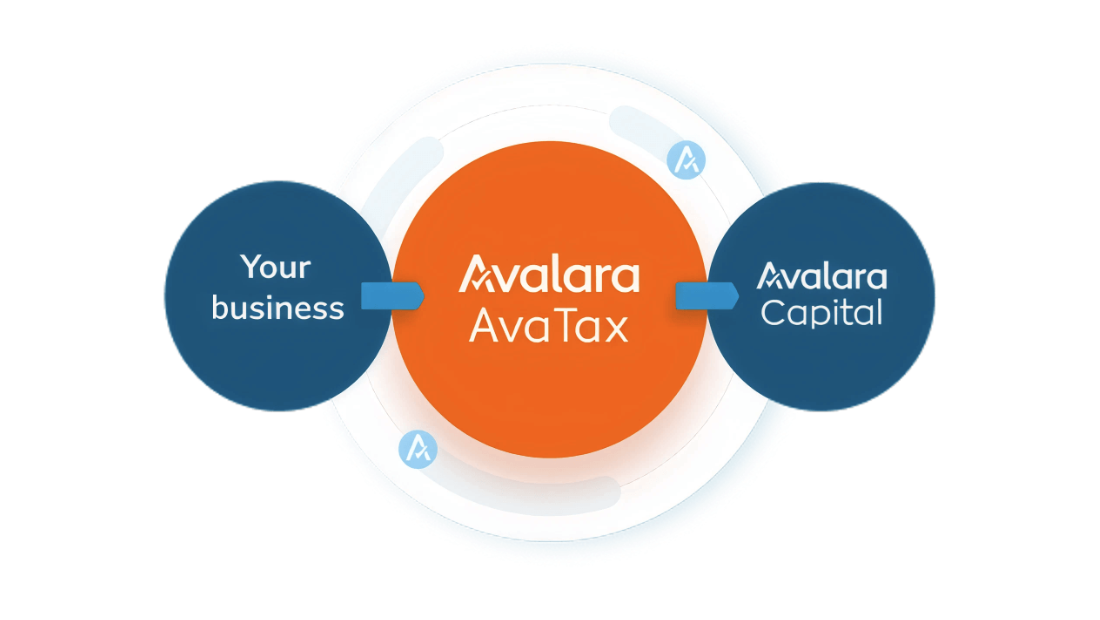
Avalara today announced Avalara Capital, an embedded working capital product that offers revolving lines of credit to AvaTax customers directly from within the Avalara dashboard. The product is positioned as a way for businesses to cover tax liabilities without draining operating cash.
The lending itself is handled by Oat Financial, a licensed fintech lender. Avalara is not the lender. It is the distribution and data layer. Businesses apply from inside their AvaTax dashboard, and Avalara qualifies them by pulling accounts receivable data through existing ERP integrations with QuickBooks Online, NetSuite, and other connected systems. Approvals can happen in minutes with no hard credit check. The product page describes it as “fast AR financing” with automated repayment schedules via ACH.
The product is only available to current AvaTax users. Eligibility depends on having substantial outstanding AR visible through ERP connectors. Credit limits scale with repayment history. There are no idle fees or mandatory draws.
Why This Matters
The announcement itself follows a well-established playbook. Intuit has been embedding payments, lending, and banking into QuickBooks for years. Sage launched embedded vendor payments through its MineralTree partnership in mid-2025. Acumatica embedded BILL for AP automation last fall. Even the Intuit-Affirm BNPL partnership announced earlier this year fits the pattern. Software platforms are becoming financial services distribution channels.
What makes the Avalara move different is that Avalara is not an ERP. It is a tax compliance engine that integrates into ERPs. Those integrations were built and authorized so Avalara could read transaction data for tax calculation purposes. With Avalara Capital, that same data pipeline is now feeding a third-party lender’s underwriting model.
This raises a question that ERP publishers should be thinking about carefully: who controls the right to monetize the data flowing through platform integrations?
Platform Control Question
When an ERP publisher like Sage, Acumatica, or Microsoft certifies an ISV integration, the publisher is granting access to customer financial data. The implicit assumption is that the ISV will use that data to deliver its core product. In Avalara’s case, that product is tax compliance.
Avalara Capital suggests a broader ambition. The same ERP connectors that read AR data for tax purposes are now being used to assess creditworthiness and distribute lending products. The ERP publisher did the work of acquiring and retaining the customer. The ISV is now extracting additional financial value from that relationship through a channel the publisher may not have anticipated when the integration was first approved.
This could lead to tighter API agreements and more restrictive terms around secondary use of data accessed through ERP integrations. It could also accelerate the trend of publishers acquiring fintech capabilities to keep that monetization in-house.
There is already evidence of this. In January 2026, Acumatica acquired CoreChain Technologies, an embedded B2B payments provider. If ISV partners are going to use platform integration data to build lending and payments businesses, publishers may conclude they would rather own those capabilities directly than collect a smaller commission through a marketplace listing.
What to Watch
For ERP consultants and ISVs, the practical takeaway is this – integration partners have financial incentives to use client data in ways that extend beyond their original product scope. As more ISVs discover that ERP connector data can support fintech revenue streams, we may see publishers respond with stricter data governance policies, more acquisitions in the payments and lending space, or both.
Avalara Capital is a small product today. But the pattern it represents, a non-ERP ISV monetizing publisher-authorized integration data through embedded financial services, is worth watching closely.
Avalara Capital is available now to eligible AvaTax customers in the U.S. Loans are made, originated, and serviced by Oat Financial.