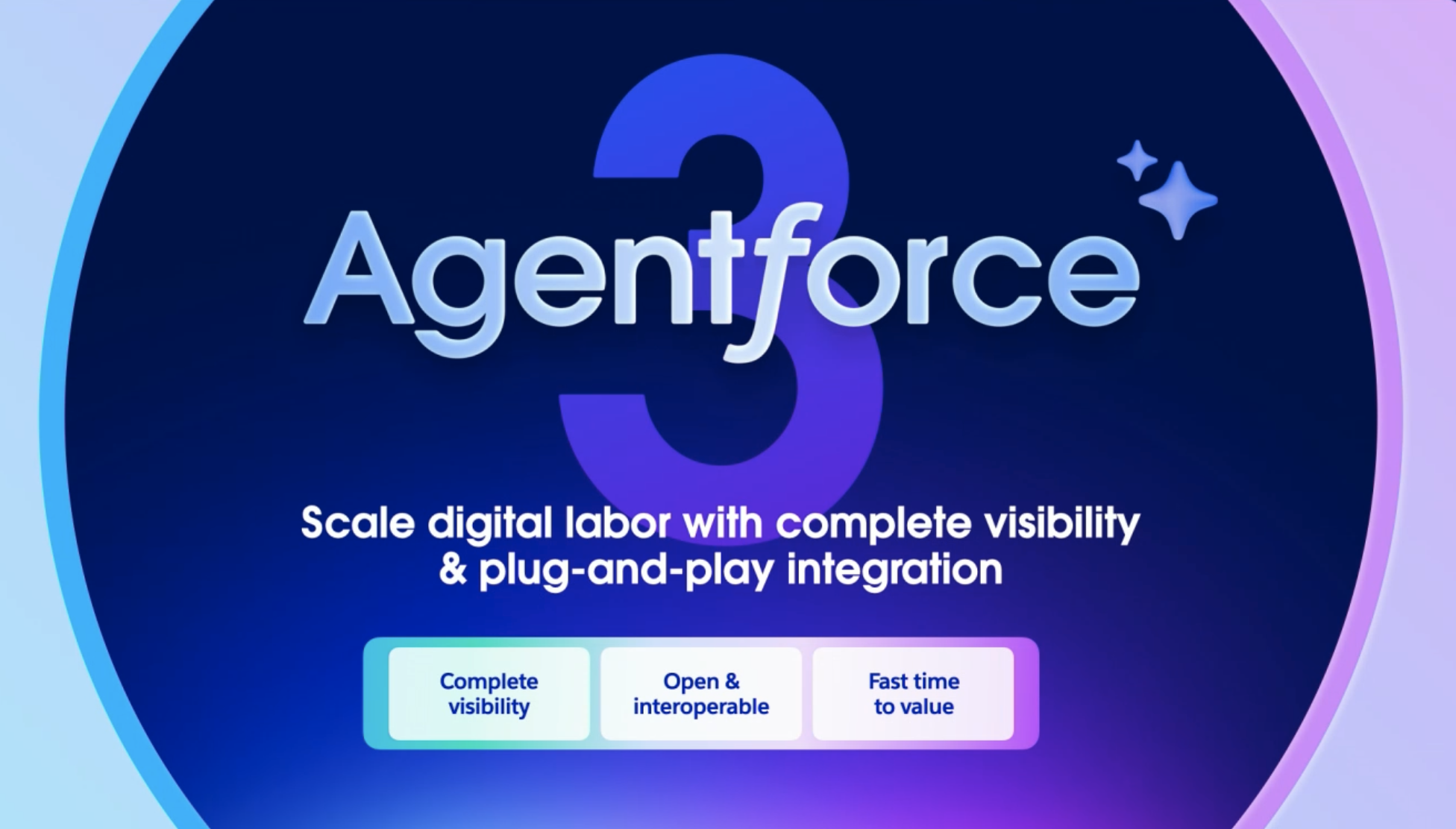
Salesforce today unveiled AgentForce 3, a platform enhancing hybrid human-AI workforces with new features like the Command Center for AI agent observability, expanded interoperability via Model Context Protocol (MCP), and over 200 pre-built industry actions. Goodyear shared their transformation journey using AgentForce to improve customer engagement and operational agility.
The Evolution of Agentforce: From Predictive Insights to Autonomous Action
Salesforce’s journey with AI began much earlier than many realize, with internal research starting in 2014, and public introduction through Einstein in 2016, focusing on predictive AI. This laid the groundwork for a significant leap forward last year at Dreamforce when Agentforce was first introduced in September 2024.
Agentforce marked a pivotal shift to autonomous AI agents. These are sophisticated software systems designed to reason and act independently. They can comprehend a problem, understand their operational environment, and then take necessary actions using available tools, workflows, and data. The core mission for Agentforce was to provide “always on, constantly available and deeply trusted” assistance for organizations overwhelmed with work. A crucial aspect of this trust is ensuring agents follow instructions, operate within business guardrails, and only access permitted tools and data.
Following its initial release, Salesforce rapidly introduced enhancements:
- Agentforce 2.0, launched in December 2024, expanded the platform’s reach beyond traditional CRM use cases to virtually any business function or team, especially where work happens (like Slack, which Salesforce owns). This version introduced a new library of pre-built skills and broader system connectivity.
- Agentforce 2dx, released in March 2025, brought the first dedicated lifecycle tooling for AI agents. This included tools for building and testing agents, such as a testing center that helps balance regression testing with the non-deterministic behavior of agents. It also enabled proactive agentic AI, allowing agents to operate autonomously in the background and be triggered by data changes.
At its heart, Agentforce aims to provide a “relief valve” for organizations drowning in menial work, freeing up human experts and full-time employees to focus on more meaningful, higher-value tasks. For example, in contact centers, Agentforce can handle constant scheduling needs, like booking a pediatrician appointment at odd hours, relieving the burden on staff. Adecco Group, a large staffing firm, uses Agentforce to achieve 100% engagement with job applicants, handling interest matching, scheduling, and resume reviews, often without human interaction. Even smaller businesses, like Pacific Dental Company, leverage Agentforce for scheduling, addressing bottlenecks caused by insufficient front office staff. Salesforce itself utilizes Agentforce on its help page, solving 83% of customer queries without human intervention and nearly doubling weekly conversations. Agentforce agents can even be embedded via API into external applications, providing contextual support within those systems.
Announcing Agentforce 3: Completing the AI Agent Lifecycle
Today, Salesforce introduced Agentforce 3. This new release focuses on empowering organizations to not only build, test, and deploy AI agents but also to measure, manage, and optimize them as they increasingly integrate into a hybrid workforce where humans and AI agents collaborate seamlessly.
Key highlights of Agentforce 3 include:
- Agentforce Studio: This is presented as the first unified experience designed to manage the entire AI agent lifecycle, from design and testing to deployment and continuous optimization. It includes a new tool called Optimizer, which allows users to dive into every single interaction an agent has had, monitoring performance, uncovering trends, and identifying pitfalls like escalating failure rates. Optimizer also recommends tweaks to agent instructions or workflows to improve performance.
- AgentForce 3 introduces the Command Center, enabling real-time monitoring, management, and optimization of AI agents aligned with business KPIs across departments
- Deep Enterprise Interoperability (MCP): Agentforce 3 wholeheartedly embraces Model Context Protocol (MCP), a crucial open standard for AI interoperability.
Ryan Schellack, Senior Director, Product Marketing – AI at Salesforce describes MCP as a “USB-C for AI”. It standardizes how AI models or agents access tools, resources, and prompts from external systems, eliminating the need for complex, bespoke APIs.
For instance, Agentforce can use its native MCP client to create an invoice via a PayPal MCP server, simplifying what would otherwise be a significant development and maintenance effort. Salesforce is expanding its Agent Exchange to include a roster of vetted MCP servers, making it easier to discover and use these expanded capabilities.
Salesforce emphasizes robust governance, authentication, and access controls wrapped around MCP support, ensuring enterprise-grade security. This approach effectively transforms external system resources into capabilities directly accessible to agents, expanding their “utility belt” without burdening IT with extensive API work. MuleSoft and Heroku also support MCP, integrating it across the Salesforce platform. - Enhanced Atlas Architecture: The underlying Atlas Trust and Reasoning Engine has been updated to provide unmatched enterprise readiness. This includes 30% lower latency and streaming responses for perceived speed, greater accuracy through web search as a data source and inline citations, and enhanced resiliency with automatic model failover between providers. Agentforce 3 also expands LLM choice, offering Anthropic (via Amazon Bedrock) hosted on Salesforce infrastructure, with Google’s Gemini planned for later in the year.
- Global Expansion: Agentforce 3 is expanding its global footprint, deploying to Canada, the UK, India, Japan, and Brazil to serve AI agent traffic within those regions. It also adds general availability support for 6 new languages (French, Italian, German, Spanish, Japanese, and Portuguese), with over 30 more languages rolling out in the coming months.
- Flexible Pricing: New SKUs for Sales, Service, and Industry Cloud are being introduced, offering per-user pricing with unlimited usage for employee-facing agents, designed to help teams get started quickly and scale boldly.
Agentforce 3 represents Salesforce’s commitment to continuously deliver on customer needs, enabling organizations of all sizes, from large enterprises like Adecco Group to small and medium businesses like Pacific Dental Company, to capitalize on the AI agent moment. This innovation promises to unlock significant human productivity, freeing up valuable time for more strategic and empathetic work.
Via: Salesforce – Agentforce