Intuit reported earnings August 25, 2026. FY2026 revenue grew 14%, but FY2027 guidance slows to 9%-10%. Mailchimp, acquired for $12 billion in 2021, is forecast at -1% to 0% growth amid increased customer churn. TurboTax revenue growth is expected to slow from 7% to 2%-3%, with Intuit acknowledging that price is causing some customers to leave for lower-cost alternatives. Analysts raised AI and new competitors as potential threats, but Intuit says its immediate problems are largely tied to its own strategic choices, slower customer acquisition, pricing pressure and churn.
The bigger story isn’t profitability, but where future growth will come from. QuickBooks remains strong, but Mailchimp revenue has essentially flatlined for three years, TurboTax is losing customers on price, and Intuit’s online customer growth has slowed. Beginning in FY2027, Intuit will report Mailchimp as a separate business segment rather than burying it inside Global Business Solutions, making its performance easier to track. Intuit is also focused on selling more services to existing users while adjusting pricing by market, including higher effective prices in parts of QuickBooks and Mailchimp while accepting lower initial revenue per TurboTax DIY customer to regain users.
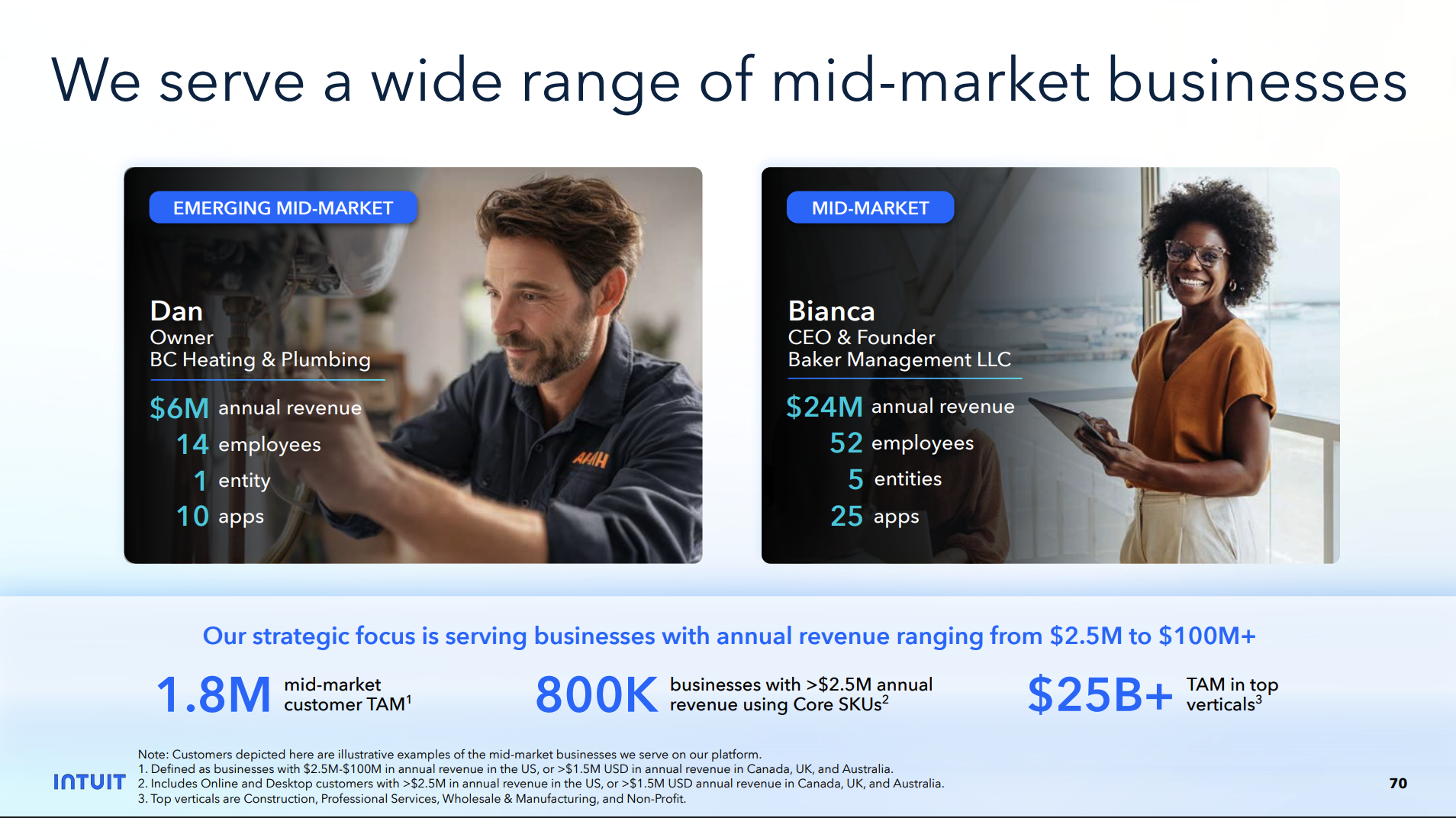
Intuit has concentrated investment around three growth initiatives (what the company terms “Big Bets”): moving QuickBooks further into the mid-market, expanding financial services such as payments and lending, and growing assisted services such as TurboTax Live. All three are producing results. Mid-market revenue grew 39% in FY2026, Online Money grew 31%, and TurboTax Live revenue grew 37%. Intuit says these three “Big Bets” collectively grew 34% and accounted for about 30% of revenue.
The caution is that much of this growth came from existing customers buying more. Roughly three-quarters of mid-market customer additions came from upgrades or desktop migrations, while more than three-quarters of TurboTax Live additions came from existing DIY customers moving to the assisted service. Intuit now says it needs to put more emphasis on attracting entirely new customers.
TLDR: Intuit’s problem is broader than Mailchimp. Management acknowledges that new customer growth has slowed and says it needs to rebuild acquisition while continuing to get more value from existing customers. Mailchimp remains the clearest trouble spot, with increased churn and revenue expected to be flat or down despite higher prices. Analysts pressed Intuit on whether AI and new competition signal a deeper problem, while CEO Sasan Goodarzi argued that much of the slowdown reflects Intuit’s own investment choices and execution gaps rather than outside competitive pressure. No public activist campaign targeting Intuit or prominent calls for Goodarzi’s exit have surfaced. Yet. But the roughly $12 billion Mailchimp acquisition happened on his watch, and Intuit’s decision to report the stalled business separately will give investors a much clearer view of how that investment is performing.