Guest post by Nicole Ronchetti
Acumatica 2026 R1 is not important because it adds more AI language to the product story. Enterprise software has enough of that already.
What makes this release worth paying attention to is something simpler and more useful: Acumatica is trying to turn modernization into action. In 2025 R2, the company introduced the broader framework, including a generally available Modern UI and the debut of AI Studio. In 2026 R1, it starts connecting that strategy more directly to day-to-day operations through AI Assistant, stronger visibility tools, more connected workflows, and deeper industry functionality.
25R2 set the direction. 26R1 tries to prove the value.
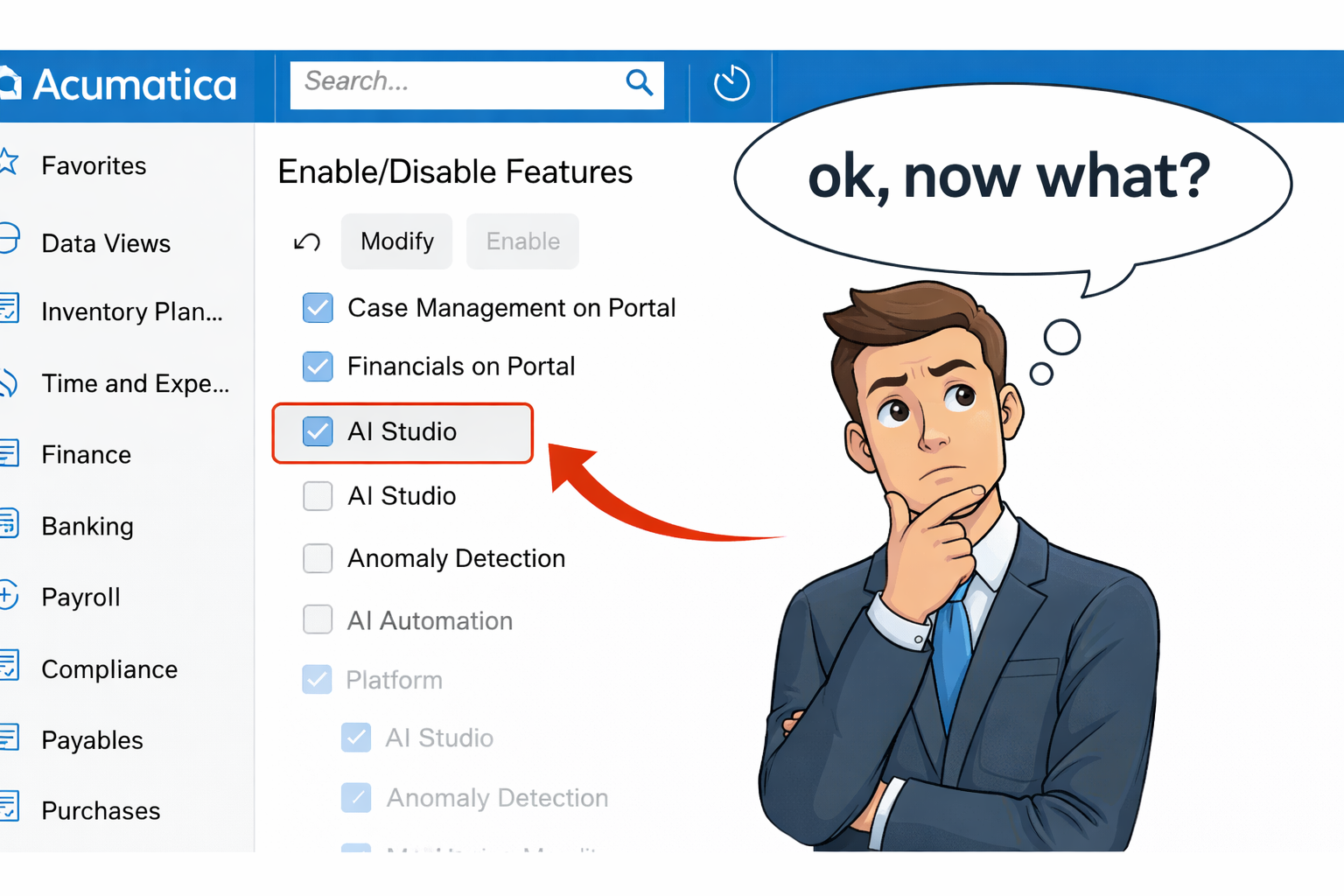
To understand 26R1, you have to start with 25R2. That release pushed two major ideas. First, Acumatica’s Modern UI became generally available, with cleaner layouts, screen personalization, and a broader effort to modernize the user experience. Second, AI Studio arrived as a configurable way to build AI-powered automations inside ERP workflows using external large language models.
That was an important shift, but not the same thing as broad customer enthusiasm.
AI Studio may be strategically interesting, but many customers are still treating it as a “maybe later” feature. That is not a knock on the product. It is just the reality of ERP buying behavior. Most organizations are still trying to decide whether the use case is compelling enough, whether the configuration effort is justified, and whether governance around prompts, models, and data is mature enough to make the exercise worthwhile. AI Studio asks customers to think beyond the release demo and define real business value. That is harder than it sounds, especially in organizations still wrestling with basic workflow friction.
The same goes for Modern UI. Acumatica clearly sees it as the future, but many customers are still delaying the transition. That hesitation is understandable. A UI change inside ERP is never just visual. It means retraining users, revisiting customizations, managing resistance, and accepting a period of disruption. The pressure to move is becoming more real, even if many customers would still prefer to postpone it until they have no choice.
That context matters, because it changes how 26R1 should be read. This is not the release that suddenly makes everyone excited about AI or eager to migrate to Modern UI. It is the release that does a better job of answering the practical question customers actually care about: what do we get in return for dealing with the change?
Acumatica is moving from framework to execution
That is where 26R1 becomes more interesting.
The flagship example is AI Assistant. Acumatica says the assistant can analyze financial and operational data and return answers in formats like text, charts, and tables. The broader 26R1 rollout also includes governance features such as data masking, usage monitoring, reusable instructions, and anomaly-related intelligence tied to operational analysis. This is a meaningful step beyond simply saying, “we have an AI platform.” Acumatica is trying to make intelligence feel closer to the user and closer to the work itself.
There is still an asterisk here, and it is an important one. Acumatica says customers get experimental or early access to AI Assistant in 26R1, with broader availability planned later in 2026. So the real takeaway is not that Acumatica has fully solved AI inside ERP. It has not. The real takeaway is that the product direction is becoming clearer and more usable. That matters, because clarity is what 25R2 sometimes lacked.
I also reviewed the Acumatica DACs between 25R2 and 26R1 (Data Access Classes — the code-level definitions that map to database tables and define how the application reads and writes data), and what stood out was what did not happen. There do not appear to be sweeping DAC-level changes that suggest a major structural overhaul underneath the application. That makes 26R1 more interesting in a different way. The real movement is happening above the DAC layer, in the user experience, reporting, workflow, intelligence, and industry-specific operational capabilities. For customers evaluating this release, that is useful. It means the upgrade conversation should center less on abstract platform drama and more on whether the business is prepared to use the new capabilities well.
The strongest theme in 26R1 is visibility
Acumatica’s four headline themes are fine, but the most compelling one may be visibility.
ERP systems rarely fail because they lack data. They fail because data is delayed, fragmented, buried, or too annoying to interpret in the moment someone needs it. 26R1 leans hard into real-time operational awareness. Acumatica highlights shop-floor kiosks, mobile time capture, in-transit inventory visibility, more responsive workflows, and stronger reporting across multiple editions. That is a much more valuable direction than simply adding more records, more screens, or more jargon.
For manufacturers, that shows up in one of the strongest parts of the release. Acumatica’s new Shop Floor Kiosk is designed to let workers capture production data directly on the floor through a simplified interface, while additional enhancements include seconds-level production timing and in-transit inventory visibility for planning. Those are not decorative features. They are operational controls that can directly affect labor accuracy, production visibility, and planning quality.
For construction firms, 26R1 pushes harder on earlier risk detection and tighter cost control. Acumatica highlights automated revenue percentage calculations, quantity- and unit-rate-based cost projections, and AI-driven forecasting embedded into project workflows. The theme here is pretty clear: fewer surprises, earlier warnings, and better project economics. That is the kind of language construction users actually care about.
For professional services and field service teams, the release adds improved mobile time tracking, more flexible timecard configurations, and reporting such as employee utilization, project revenue analysis, and unbilled project revenue aging. Again, the pattern is not flashy innovation for its own sake. It is better control over margin, timing, and visibility.
And for distributors, Acumatica is pushing smarter fulfillment and profitability control, positioning 26R1 as a response to warehouse complexity, inventory movement, and volatile supply chain conditions. That is a practical story, and probably a stronger one than the AI headline if we are being honest.
The upgrade question is no longer just technical
For customers coming from 25R2, 26R1 should not be treated as a routine half-step. It is the release where Acumatica’s recent strategy starts becoming more tangible.
25R2 introduced important ideas, but many of them still felt like future-state concepts. Modern UI was clearly where the company wanted customers to go, but many were not ready to make the leap. AI Studio signaled ambition, but not necessarily immediate value in the eyes of users. 26R1 strengthens the business case by linking those modernization efforts to more visible operational outcomes.
That does not remove the friction. Modern UI migration is still a hurdle. AI adoption is still cautious. Many organizations will still wait, test, debate, and postpone. Sensible behavior, honestly. ERP teams have been burned before by shiny new capabilities that created more work than value.
But 26R1 does improve the question customers should be asking. Instead of “what new features are in this release?” the better question is “can this help us see sooner, decide faster, and act with less friction?” That is a more serious standard, and a better one.
The bottom line
Acumatica 26R1 is less about product theater and more about product direction.
The company is trying to move from modernization as a design exercise to operational intelligence as a business outcome. That does not mean customers will instantly embrace AI Assistant. It does not mean they will rush to Modern UI with open arms and cheerful training schedules. Human beings are rarely that cooperative.
What it does mean is that Acumatica is finally getting better at answering the value question. If 25R2 laid the groundwork, 26R1 starts making the return more visible: better insight, earlier signals, tighter workflows, and industry enhancements that matter where work actually happens.
That is why 26R1 matters.
Not because it is louder.
Because it is more actionable.